In today’s growing modern world, energy storage systems (ESS) are playing a very important, game-changing role in our daily lives. Wondering, how? Suppose you are going to have a very important meeting, and suddenly the power goes out, and the Wi-Fi stops working. Everybody hates this kind of inconvenience, right?
Power outages at homes not only affect productivity but also comfort and peace of mind. Don’t you agree? Interestingly, individuals are involving sustainable solutions to reduce the cost of electricity bills and become more energy independent.
It’s not about storing electricity but making smarter choices and preparing for unexpected power outages. If you are also looking to install it, here is the comprehensive guide to residential energy storage solutions in India.
So, without any further delay, let’s get started!
What is a Residential Energy Storage System?
A Residential Energy Storage System (RESS) is set up to store electricity, typically from solar panels or the utility grid, to use it later when the energy demand is high. It is also called a home energy backup solution.
When chemistries like LFP are introduced, they ensure thermal and chemical stability of the system. They provide long service life and safely discharge upto 80-100% of their capacity without any damage.
When installed at home, the RESS stores an excess amount of solar energy during the day for better usage at night. It automatically provides power to appliances like a fridge, lights, and Wi-Fi during a grid failure.
Why Energy Storage is Becoming Popular in India?
Residential Energy Storage system is becoming popular in India due to several interesting benefits. They provide superior safety, high thermal stability, long lifespan and high round-trip efficiency. Along with that, they are cost-effective and maintenance-free, which makes them ideal for residential setups.
As today’s modern world needs technology and electricity fully, these power backups really help in enabling homeowners to maximise solar usage and cope with grid instability.
Have a look at the key reasons for the demand for RESS in India:
- Safety and Durability in Extreme Climate
- Long-Term Cost Effectiveness
- Uninterrupted Power Supply (UPS)
- Compact and Zero Maintenance
- Sustainability and Solar Integration
- Grid Stability
Types of Batteries Used in Home Energy Storage
Modern standards require efficiency for energy storage, which is used in home energy. Here are the types of batteries used in energy storage at homes.
Lead-Acid Batteries
Lead-acid batteries are commonly used in homes, which provide low-cost energy storage. These kinds of batteries are reliable, primarily in UPS units, uninterruptible power supplies, inverters for power backup and solar energy storage systems. Furthermore, they are very affordable compared to any other lithium-ion alternatives.
Lithium-Ion Batteries
Lithium-ion batteries offer high energy density, an 8 to 10+ year lifespan, support faster charging and offer a great depth of discharge. The best part about these batteries is that they don’t require any water topping or acid leakage, which lowers the cost of maintenance. Moreover, modern systems include BMS, which helps in preventing overcharging, overheating and short circuits.
Lithium Iron Phosphate (LFP) Batteries
LFP batteries are widely used in home appliances. They are a safe, long-lasting energy storage solution, especially paired with solar panels to store electricity for nighttime use or outages. What’s more? These kinds of batteries are highly stable, non-toxic and support thousands of cycles, which makes them ideal for residential backup power.
Key Benefits of Residential Energy Storage Systems
RESS provide several key benefits for homes by enabling power backup during outages.
- Reliable Backup Power: During outages, this energy storage system provides instant, automatic electricity for essential appliances.
- Lower Energy Costs: Residential Energy Storage System ensures low-cost energy and use during high-rate, peak demands. However, the process is known as peak shaving or arbitrage.
- Increased Energy Independence: It fosters more self-sufficient home energy storage, which reduces reliance on the utility from the solar panels for use at night.
- Maximising Solar ROI: The utilisation of solar panels stores excess energy that would either be sent back to the grid or just boost the ROI, which means return on investment.
- Environmental Sustainability: When it comes to RESS, which are made from Lithium Iron Phosphate, it supports environmental sustainability.
- Increased Property Value: When someone installs a Residential Energy Storage System, the overall value of a home increases, due to the addition of modern, sustainable and reliable energy capabilities.
Important Factors to Consider Before Installing Home Energy Storage
Installing home energy storage is not an easy process. It allows individuals to analyse their daily energy consumption, desired backup and battery capacity needs. Here are the key factors to consider before installing RESS.
- Energy Needs & Goals: Find your goals by determining backup power during outages, reducing electricity bills or maximising self-consumption of solar energy.
- Battery Capacity & Power Rating: Check the capacity of Residential Energy Storage Systems in India, which will help you to know how many devices can run simultaneously during consumption.
- Compatibility: Choose the correct coupling method, DC or AC coupling and then check the voltage compatibility.
- Safety & Installation Location: It is important to ensure the system meets all the safety standards, like UL 9540/9540A. Also, choose a suitable, accessible and safe location for installing the ESS at homes.
- Lifespan & Warranty: Lithium Iron Phosphate batteries last for 10 to 15 years, as compared to traditional lead acid batteries. Before buying a battery system, it is suggested to first check out the warranty to ensure a guarantee, in case it fails.
- Future Scalability & Needs: Figure out your future energy needs. For example, if you are adding an EV or expanding your home, you will need a large, scalable battery system.
Cost of Residential Energy Storage Systems in India
Here is the pie chart which shows the estimated cost of RESS in India:
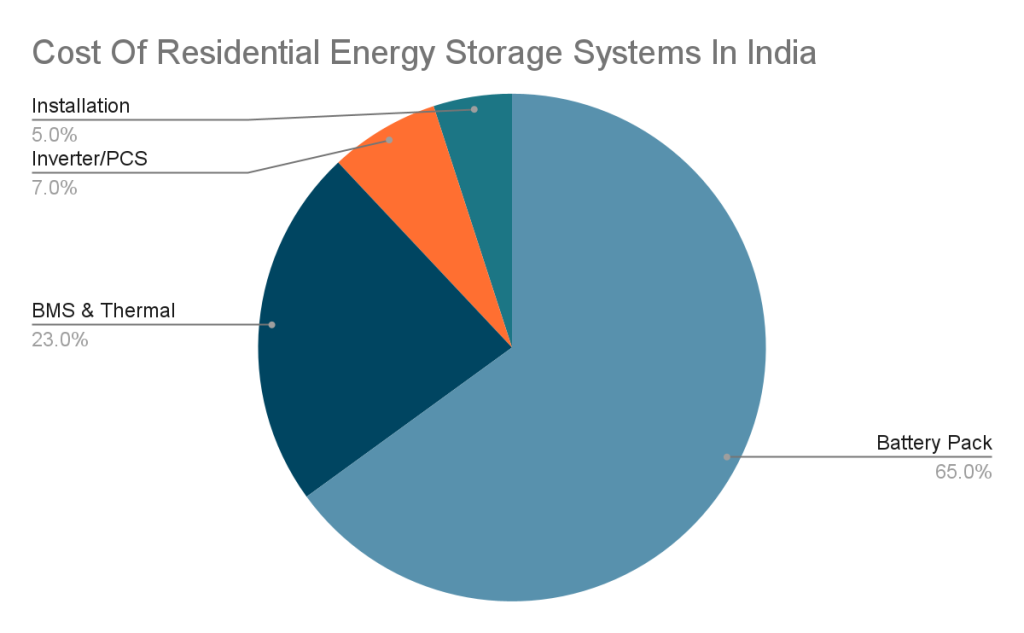
- Note:- It is an estimated cost information while installing a RESS in India. However, the cost may vary depending on various factors, and it is heavily influenced by the adoption of technology. Furthermore, for 2-3 BHK homes, the battery costs around ₹3 lakh to ₹10 lakh for a typical 5-10 kWH system.
Future of Residential Energy Storage in India
The future of RESS in India is rapidly growing towards Lithium Iron Phosphate (LFP) batteries as they are safer, reliable, durable and long-lasting. Also, they are maintenance-free as compared to lead acid. That’s the reason they have become a preferred choice for residential solar-plus storage.
Furthermore, LFP batteries are ideal for India’s climate as it has built-in BMS battery management system, which helps in protecting from overheating and overcharging. The government is also supporting domestic production through the Production Linked Incentive (PLI) scheme worth ₹18,100 crore ($2.14 billion). Overall, they are making a set-and-forget solution for busy homeowners.
In A Nutshell
Here is the end of this guide!
Residential Energy Storage in India has become an important, cost-effective and smart solution for homes. The consumption of electricity has increased drastically, and it has become an important part of life. That’s the reason individuals started investing in RESS to ensure a smooth lifestyle.
If you are also thinking of installing residential energy storage systems at your homes, feel free to connect with Lifion Energy, the best LFP Battery Manufacturer in India, offering significant benefits by allowing homeowners to store energy.
So, optimise these renewable energy consumption by installing at homes and have a great peace of mind as they don’t need maintenance!
