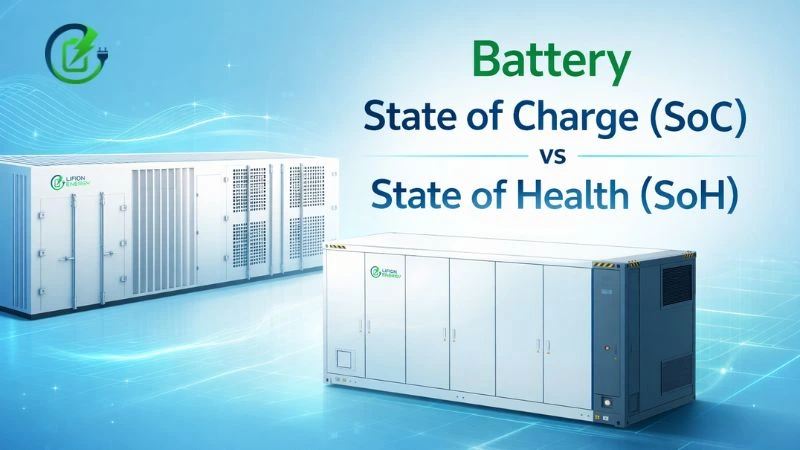
As we all know, LFP batteries have become the backbone of modern technology, from your smartphones to laptops, every system needs a reliable battery to run. Don’t you agree? To ensure their reliability, performance and longevity, 2 major critical metrics are needed: SoC and SoH.
Well, these are the 2 technical terms used to measure the overall working process of a battery, where SoC represents the battery State of Charge and SoH means battery State of Health. Don’t worry, in this comprehensive guide, you will get to know about everything from their definition to ways to maintain the optimal battery performance.
So, without any delay, here is a blog for you!
Understand The Terms: (SoC) Vs (SoH) Battery
Firstly, you need to understand the terms SoC vs SoH battery and their works separately.
State of Charge (SoC)
The percentage of energy remaining in a battery in relation to its maximum capacity is known as the State of Charge (SoC). In other words, a battery is fully charged if its (SoC) is 100%, and it is totally discharged if its (SoC) is 0%.
For applications like electric automobiles, solar energy storage, and portable electronics, (SoC) offers an instantaneous snapshot of available energy, much like a fuel gauge in an automobile.
- Real-life example: The top right corner of your phone screen shows (SoC), from which individuals figure out their charging or discharging time.
- The State of Charge (SoC) = Qrem/Qmax x 100%
Where Qrem means the remaining capacity and Q max describes the nominal capacity.
State of Health (SoH)
The State of Health (SoH) evaluates a battery’s long-term health by contrasting its performance with that of a brand-new battery. For instance, a battery with 80% (SoH) can only provide 80% of its initial capacity.
(SoH) assists in determining whether a battery needs to be replaced or if it is still dependable. This is particularly important for high-energy storage systems, medical equipment, and electric cars.
- Real-life example: When a battery of a smartphone charges to 100%, it lasts for all day until 2 PM, and the capacity is only 75% when it was new, leading to shorter daily usage.
- State of Health (SoH) = 100 x Qmax/Cr
Where Q max is the ratio of the maximum available charge
Cr = is rated capacity
Quick Comparison: SoC vs. SoH: Key Differences
Get a quick comparison of SoC vs SoH:
| Metric | State of Charge (SoC) | State of Health (SoH) |
| Measures | Current energy level | Long-term battery condition |
| Definition | Available energy remaining | Current capacity (compared to new) |
| Unit | Percentage (0–100%) | Percentage (0–100%) |
| Testing Methods | Voltage / Coulomb counting | Capacity / Resistance tests |
| Timeframe | Short-term snapshot | Long-term performance |
Relationship Between (SoC) and (SoH)
(SoC) and (SoH) are managed by a Battery Management System (BMS). Both are interconnected distinctly or critically. For instance, if (SoC) indicates the current, the (SoH) represents long-term ageing status as compared to the original capacity of a LFP battery.
Here is the quick overview regarding (SoC) vs (SoH):-
- SoC Affects SoH: The State of Charge (SoC) really affects the State of Health (SoH) due to overcharging and frequent deep discharges of the LFP battery, which leaves it under stress and lowers its general health.
- SoH Affects SoC Accuracy: The State of Charge (SoC) estimates become less accurate as the battery ages, which also loses its capacity. To increase accuracy, battery management systems (BMS) account for these variations. Indeed, battery management systems (BMS) matter for safety & performance.
Additional Information: (SoC) vs (SoH)
The main goal of (SoC) contributes to the battery’s health protection. The battery’s life can be shortened and ageing accelerated by overcharging and deep draining, both of which happen when the (SoC) is outside of the optimal range (20% to 80%).
The Impact of (SoH) on (SoC) Accuracy
Measuring (SoC) becomes increasingly challenging as a battery ages and its (SoH) decreases. However, batteries that are getting older may lose charge more quickly or display improper (SoC) readings. By modifying (SoC) calculations depending on variables like internal resistance and historical usage patterns, innovative systems now take these changes into LFP batteries.
Why Do Both SoC and SoH Matter?
Inaccurate SoC/SoH estimates result in difficulty in both safety and economic efficiency in areas where dependability is unachievable. Businesses deal with early cutoffs, range anxiety, decreased performance, unanticipated failures, and higher warranty expenses.
Technically, the greater the understanding of the device capacity, the more precise the (SoC) and (SoH) characteristics are. The better battery data now translates into extended battery life and reduced expenses later on.
How to Maintain Good SoC and SoH?
Here are some of the ways to maintain good (SoC) and (SoH) accordingly.
- Consistent Observation
To stop degradation of LFP batteries, periodically evaluate both (SoC) and (SoH) using technologies such as Battery Management Systems (BMS). That’s the reason why LFP batteries stand out the most compared to traditional batteries.
- The Best Ways to Charge
To lessen stress and avoid overcharging or deep draining, charging batteries between 20% and 80% is the ideal way to charge. Set a daily limit of charging to 80% and avoid discharging below 20%.
- Control of Temperature
LFP batteries should not be exposed to extremely high or low temperatures, since this can have a substantial impact on (SoC) accuracy and (SoH). It is advised to keep them in a stable, temperate environment whenever possible.
- Maintain Optimal Storage Conditions
To extend their lifespan and avoid deterioration, store unused batteries at about 50% charge in a cool, dry environment and disconnect them from all loads to prevent them from parasitic drainage. However, the ideal temperature for storing batteries is from 10°C to 25°C (50°F to 77°F).
- Routine Checks
When (SoH) drastically drops, replace the battery and clean the terminals to ensure efficient energy transfers. If you want to increase the overall efficiency of a battery from (SoC) to (SoH), monitor and do routine check-ups of the battery.
Common Myths About SoC and SoH
Here are some of the common myths about (SoC) and (SoH):
- Myth 1: Even EV batteries decrease over time due to their chemical reaction degradation, leading to the reduction of range (SoH drop).
- Myth 2: Many individuals think charging up to 100% is best, but the reality is it accelerates the degradation of (SoH) when charging with high-voltage fast charges daily.
- Myth 3: Even if the battery percentage is 50%, there are several factors which decide how quickly the energy is used.
- Myth 4: Individuals think battery diagnostics are instantaneous, but it is not just the 100% charge; it’s about how old the battery is and just how full it is.
- Myth 5: A battery with 70 % to 80% still operates, but it loses capacity as compared to a new battery, which leads to a reduction in the battery range.
In A Nutshell
Here is the end of this guide!
After reading, you might understand that both State of Charge (SoC) and State of Health (SoH) are crucial part of LFP batteries, which are eventually managed by the battery management system (BMS). However, these 2 factors enhance overall battery performance, extending lifespan and also ensuring safety to prevent short circuits.
Following the optimal charging method and maintaining proper storage conditions helps in significantly increasing the longevity and reliability of a battery. If you also want to get the right energy storage solutions, it’s time to connect with Lifion Energy, the best LFP Battery Manufacturer in India.
So, why wait? Discover the State of Charge (SoC) and State of Health (SoH) to maintain the overall quality of LFP batteries!
FAQs about SoC and SoH
Q. What is the state of health of a battery (SoH)?
The State of Health (SoH) helps in measuring the percentage of batteries by comparing the current maximum energy capacity to its original capacity (when new).
Q. When to repair a car battery’s state of health (SoH)?
Attempting to repair a car battery’s state of health is only required when the battery starts showing signs of degradation or any physical damage has occurred. However, the optimal time is when the (SoH) State of Health drops around 70% to 80% or below 60%.
Q. What is the difference between the SoC and SoH of a battery?
State of Charge (SoC) indicates the current energy of a battery, which ranges from 0 to 100%, whereas State of Health (SoH) represents the overall health of a battery’s capacity and condition when it is new.
Q. What is the full form of SoC and SoH of the battery?
The SoC and SoH are 2 critical factors in rechargeable batteries. Here is their full form:
- SoC = State of Charge of a battery
- SoH = State of Health of a battery
Q. How to check the SoH of the mobile battery?
Either use a formula to check the SoH State of Health of a battery or use built-in settings, third-party codes and diagnostic codes.
Q. What is the meaning of 80% in the SoC battery?
An SoC 80% reading means the battery is 80% of its usable energy remaining. However, the actual runtime depends on several factors.