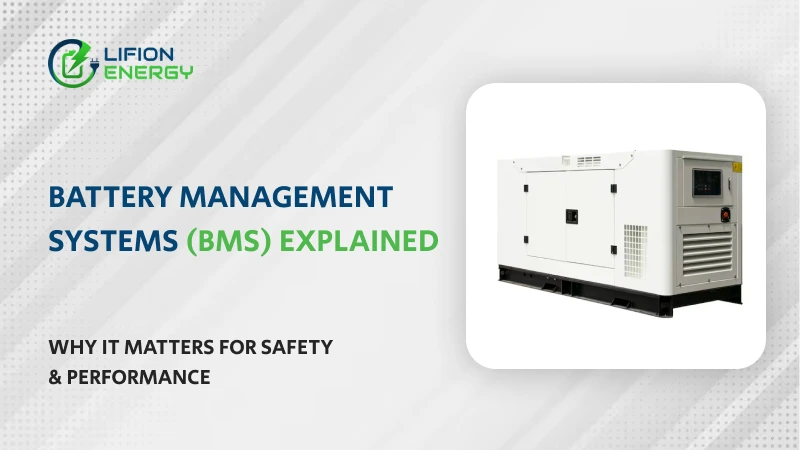
In the modern-world of Lithium Iron Phosphate, the Battery Management System (BMS) plays an important role in ensuring safety, performance, stability and life cycle reliability. It is an advanced controller that guarantees more powerful energy storage solutions.
However, a BMS is involved with every rechargeable battery pack, and without incredible chemistries like lithium-ion, LiFePO4, it wouldn’t even function properly. Well, in this guide, we will understand the definition of BMS, its functions, working principles, and benefits.
It’s time to understand the right information about BMS and know why it matters for the safety and performance of LFP batteries. So, without any further delay, let’s get started!
What Is a Battery Management System?
A Battery Management System (BMS) is referred to as an electronic control system that regulates and manages rechargeable battery packs. However, the major function of BMS is to prevent damage to the battery cells and increase the lifespan by preserving operating conditions.
There are many cells coupled in parallel or series to make a comprise size battery Lithium Iron Phosphate batteries pack. However, BMS take care about metrics and responds when anomalies arise.
Simply, BMS is a system that monitors, protects and controls batteries and also prevents problems like overcharging, deep discharging, overheating or short circuits. Along with that, it also provides safety, longevity and performance in LFP batteries.
How to Use a Battery Management System?
The BMS is integrated into battery packs to provide great energy storage solutions for end users. It is wired to every individual cell in the battery pack for voltage monitoring. Also, it attaches to the main power terminals for current monitoring.
Here is a little breakdown of battery chemistry and application:
- For EVs: In every cell, BMS ensures to deliver even power, which further prevents dangerous thermal runaway events.
- For Energy Storage: The major role of BMS is to optimise charge/ discharge cycles just to maximise usable capacity.
- For Electronics and mobility devices: The BMS requires compact battery packs to deliver safe and high performance in a limited space.
Types Of Battery Management Systems
Have a look at the types of Battery Management Systems:
- Centralised BMS Architecture
This type of BMS in energy storage systems is a single controller board which manages all the cells in a battery pack. However, it is the simplest and cost-effective system, but less scalable.
- Modular BMS Topology
Modular BMS Topology divides the battery pack into modules, and each has its own BMS, which provides flexibility and redundancy for medium to large battery packs
- Master/Slave BMS
As the name suggests, it is the master controller that coordinates multiple slave units. It is commonly used in EVs where several modules can communicate seamlessly.
- Distributed BMS Architecture
The Distributed BMS Architecture ensures each cell has its own monitoring and balancing circuitry. However, it is highly accurate and scalable. Also, these kinds of LFP batteries are reliable for several large-scale applications like grid storage and EV fleets.
Benefits of a Battery Management System
After understanding the definition and types of BMS, it’s the right time to know about its benefits.
- Functional Safety
The BMS adhered to safety regulations, including EVs. It avoids disastrous malfunctions like cell imbalance or excessive heat.
- Extended Lifespan and Reliability
The BMS maintains cell balancing and avoids stressful situations, which eventually extend the lifespan and reliability of LFP batteries.
- Optimised Performance and Range
BMS in energy storage systems optimise to power the delivery and also drive the range, especially in EVs, with the help of calculations and managing available power.
- Reduced Cost and Warranty Risks
Even if it increases upfront costs, installing BMS for LFP battery lowers long-term costs term risks by avoiding premature battery failure and warranty claims.
Importance Of BMS Safety And Performance
Let’s understand safety and performance in BMS in Lithium Iron Phosphate batteries:
- BMS for Safety – The BMS in LFP batteries prevents overheating and mitigates the risk of thermal runaway, fires and explosions. Basically, it detects when cells exceed the voltage thresholds and eventually prevents damage, gas generations and capacity loss. Also, it provides real-time continuous monitoring to ensure the system operates within its Safe Operating Area (SOA).
- BMS for Performance – BMS ensures cell balancing in a battery pack, maintaining equal charge levels and maximising usable capacity. It manages charge/discharge cycles to extend the overall life of the battery bank.
In A Nutshell
Here comes the end of this blog!
The BMS in energy storage systems represents the foundation of advanced technology. It guarantees cell safeguarding, performance controlling and facilitating communications. From preventing dangerous overheating problems to providing extended lifespan and reliability, the BMS does it all.
In the realm of battery power, purchase a top-notch BMS for sustainability, safety, and performance. For the same, you don’t look further, as Lifion Energy has got you covered, the best LFP battery manufacturer in India, providing the most reliable energy storage solutions. So, it’s time for a change and to get the advanced Lithium Iron Phosphate LiFePO4 solutions for various residential and industrial applications.