With so many options in choosing the best batteries, it is difficult to get the best one. Right? Are you considering the best battery for your electric vehicle or solar energy storage system? It’s really hard to make choices. Isn’t it?
Some batteries are heavy, weak or toxic, while others are lightweight, used in portable devices, and eco-friendly. However, different batteries come with different strengths and weaknesses. Discover how energy density, lifespan, safety and cost vary among these batteries.
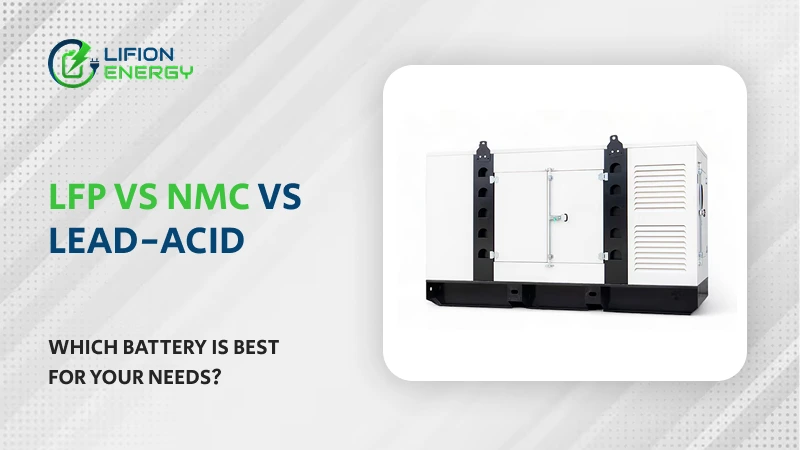
Let’s find out the best battery for your needs. In this guide, you will know about LFP vs NMC vs lead-acid batteries. Just explore the key factors and make your decision accordingly.
LFP vs NMC vs Lead-Acid
Here is the detailed comparison of LFP vs NMC battery vs lead-acid.
LFP (Lithium Iron Phosphate)
Lithium Iron Phosphate (LFP) is a type of rechargeable lithium-ion battery. It is well-known for its long cycle life, high safety and lower costs. The involvement of iron and phosphate in LFP batteries provides superior thermal stability, which eventually reduces the risk of fire.
- Uses: These batteries are commonly used in electric vehicles, residential solar applications and portable power stations.
- Advantages: High safety, longer lifespan, durability, cost-effectiveness, and stability.
NMC (Lithium Nickel Manganese Cobalt)
Lithium Nickel Manganese Cobalt (NMC) batteries are high-energy-density rechargeable lithium-ion cells. Interestingly, they store more energy in a smaller size and are best known for their superior power. Also, they perform well in low temperatures, providing a 1,000-2,000 cycle lifespan.
- Uses: NMC batteries are used in electric vehicles, portable devices such as laptops, smartphones, and other energy storage systems.
- Advantages: High energy density, temperature tolerance and cost-effectiveness.
Lead-Acid
Lead-acid batteries are cost-effective, reliable and rechargeable energy storage devices widely used for over 150 years. These are the oldest types of rechargeable battery still used today in several applications. However, it does not last as long, and its performance suffers when discharged deeply as compared to the LFP battery lifespan. Off-grid cabins or backup use these kinds of batteries.
- Uses: Lead-acid batteries are primarily used in industrial, automotive and backup power applications.
- Advantages: Lower cost, higher safety, and 99% recyclability
Here is the detailed comparison of LFP vs NMC vs lead-acid in table form:
| Features | LFP (Lithium Iron Phosphate) | NMC (Lithium Nickel Manganese Cobalt) | Lead-Acid |
| Life Cycle | 6,000 to 10,000+ cycles | 3,000 to 5,000 cycles | 500 to 1,200 |
| Lifespan (Years) | 10 to 15+ years | 7 to 10 years | 3 to 5 years |
| Depth of Discharge | 90 to 100% | 80 to 90% | 50 to 70% |
| Safety | Very safe | Moderate risk of thermal runaway | Low risk |
| Cost per kWh (approx.) | Moderate | Higher | Low |
| Maintenance | Low | Low | Medium |
| Scalability | Good | Good | Limited |
| Availability | High | High | High |
Which Battery Is Right for You?
Are you looking for a safe, long-lasting and minimal maintenance battery? If yes, then LFP (Lithium Iron Phosphate) clearly wins. These batteries are a safe, durable and cost-effective type of rechargeable lithium-ion technology.
On the other hand, NMC might be suitable for you need, but it requires frequent replacements and is also costly.
Furthermore, if you are budget-conscious, then lead-acid batteries are still an option for systems and infrequent backup power.
How to Make the Final Choice?
Even if you have all the choices, for some individuals, it is still a big task to choose a reliable battery. Are you also the one? After these answers, all your doubts will be cleared. Just ask yourself what your requirements for a battery are and why?
- Energy Usage: What are you looking for, daily cycling or backup power only
- Budget: Are you looking for a long-term investment or a lower upfront cost?
- Space Availability: Do you need a compact battery or are you ready to go with big size?
- Installation type: Which type of installation are you looking for: on-grid, off-grid or hybrid
So, make a checklist according to your priority and choose the best battery as per your needs. In addition to that, make sure your batteries have up-to-date BMS and required certifications while ensuring the quality.
In A Nutshell
That’s enough for today’s guide.
Choosing the best battery as per your needs doesn’t have to be confusing. Just understand the battery types, their uses and disadvantages to make a smarter decision that fits your energy goals.
Still having confusion regarding choosing the battery, or want a reliable energy storage solution? Then don’t hesitate to reach out to Lifion Energy, the best LFP Battery manufacturer in India, which provides advanced Lithium Iron Phosphate LiFePO4 solutions at the best prices.
So, what’s holding you back? Take advantage of such energy storage systems for a better future!
Frequently Asked Questions About LFP, NMC and Lead-Acid Batteries
Q. Which one is better, lithium-ion or LFP?
LFP (Lithium Iron Phosphate) batteries offer safety, longer life cycle and thermal stability. Whereas lithium-ion batteries have a higher density, which makes them lighter and more compact. Overall, LFP batteries are much better than any other lithium-ion batteries.
Q. What are the uses of NMC batteries?
NMC batteries offer high energy density, longer lifespan, fast charging and other safety features, which makes it a more popular choice for a wide range of applications such as electric vehicles, portable electronics, drones and other renewable energy systems.
Q. What are lead-acid batteries used for?
Lead-acid batteries are widely used in motorcycles, boat engines, cars, trucks, data centres, telecommunications, electric wheelchairs, and other recreational vehicles
Q. What is the principle of the LFP battery?
The working principle of an LFP battery is that when charging, the lithium atoms lose electrons and become lithium ions and migrate to the negative electrode through an electrolyte process.
Q. What is the lifespan of an LFP battery?
LFP batteries are best known for their exceptional longevity, which typically lasts for 10-15+ years. However, they fully charge before dropping to 80% capacity.
Q. Are LFP batteries good for cold weather?
Yes, LFP batteries are good for cold weather as they retains its longer life cycle due to robust chemistry. That’s the reason they have good cold durability as compared to other batteries, which might experience degradation.